
Learning a new language is becoming a member of the club -the community of speakers of that language.
~Frank Smith
When I was in eighth grade and planning high school classes, I wanted to take French. French was France. France was Paris. Paris was, well, Gay Pa-ree. Champagne. The Can-Can. Haute couture. String bikinis on the Riviera. To my 13-year old brain, French sounded so romantic. Ooooh, là là
My father put a quick stop to that dream. “More people in this world speak Spanish than French,” he said. “It’s closer to Latin and will help you in medical school more than French. You’ll sign up for Spanish and be happy about it.”
I signed up for Spanish, but I certainly wasn’t happy about it. All summer, I pouted. It was not fair. Spanish was Spain. Spain was what? Madrid? There was no Gay Ma-dreed. Champagne wasn’t Spanish? Did they dance? The women were probably stubby and chubby, and they probably wore all black and looked like my maternal Italian grandmother. If they even had beaches, the women probably wore bloomers. And, Spanish sounded clunky. Blah, blah, blah.
Walking into Señor Tedde’s Spanish class that first day of high school opened my eyes. The posters of the guitarists, matadors, and flamenco dancers that lined the walls of Señor Tedde’s classroom highlighted very exotic people. The men, dressed in tight, black and silver outfits and whirling large, red capes, were handsome and daring. And, while the elegant women weren’t wearing bikinis, they weren’t stubby, chubby or wearing bloomers, either. Instead, beautiful, form-fitting, ruffled dresses and long, lace mantillas covered their sleek bodies. Ay! Yai! Yai!



It didn’t take me long to decide I liked Spanish (though I didn’t admit it at home for some time). Señorita Remedio, who taught Spanish III and IV, encouraged me to consider teaching Spanish. “You love the language. You love the culture. Señor Tedde and I think you need to consider it.” She was right, and I had been thinking about it. On our way to a college fair when I was a junior, I announced to my parents that I wanted to look at colleges that offered Spanish as a major.
Without missing a beat, my father said, “You’re not majoring in Spanish. You’re an idiot. What are you going to do with a degree in Spanish? Teach? You’re too smart to teach. You’ll hate teaching. You’ll go to medical school and be happy about it.” I knew enough not to retort, “If I’m such an idiot, how will I get into med school?” and just let his comment go.
You know, some people are cut out to be doctors and nurses, and some are not. I am not. Those of you who know me well enough know that I’d be stressing constantly over whether I diagnosed someone correctly…gave a patient the right medicine….had to look at blood pouring out of a wound….and then cleaned that wound efficiently…had a patient vomit on me. No, thank you.
Que Será, Será
Two weeks after that college fair, my father, who’d had a major heart attack some years before, went to see his doctor for a regular check-up. The doctor told him he was doing so well he’d probably live another 25 years. That night, my father died in his sleep. (What did I say about diagnosing someone correctly?)
To make a long story short, I waited an appropriate amount of time and then told my mother I had no intention of going to either medical or nursing school. I was going to major in Spanish and that was all there was to it. It was Mom’s turn to pout, which she did very well.

I went to a liberal arts college, majored in Spanish, and threw in English as a second major for good measure. I started teaching, and junior high kids drove me crazy. (Kids: “Do we have to memorize these words, Señorita?” Me: “No. Put the book under your pillow and learn by osmosis.” Kids: What’s osmosis?”). Iimmediately hated it, and I know my father was having a good laugh over that one.
After Teaching
I applied to graduate school at Ohio State in, you guessed it, Spanish. Being a grad assistant and teaching college kids was better than teaching junior high kids, but I still was not wild about teaching Spanish. While I loved the language, I kept wondering what I was going to do with two more letters behind my name. Teach. I didn’t want to teach any more. I finished the coursework in Spanish but never took the tests to get those two letters.
When Mike and I moved to Atlanta, I ended up working for a major health insurance company. Since our office covered the southeast, we had many Cuban and Puerto Rican clients in Florida, so I used my Spanish skills to talk to them or to translate documents.
Bottom Line
All of this is probably not that important to what I’m getting at. Bottom line is that I speak Mexican Spanish, which is, honestly, different from Puerto Rican Spanish, Cuban Spanish, Castilian Spanish, Colombian Spanish. What I mean by that encompasses a number of things—speech patterns and pronunciation, vocabulary, slang, formality.
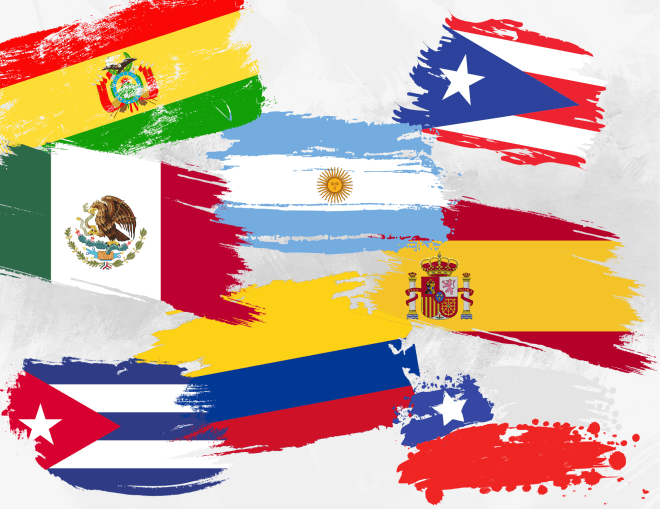
For example, in Mexico and Colombia, the Spanish is very neutral. They speak at a good pace, but they are clear. The Caribbean Spanish of Puerto Rico and Cuba is very fast and chopped. They drop letters (particularly Rs, Ss, Os at the end of words). In Spain, the language varies by region, but they all use the theta sound…. C and Z in words take on a th sound.
The vocabularies of the various countries all have influences from that particular area. You’ll find words with Mexican Indian etymology. The Cuban and Puetro Rican vocabularies have that Caribbean influence. Some words are just different from country-to-country. For instance, in Mexico, they use the word coche for car. In Cuba, it is carro.
The other differences are in formalities, which are not quite as evident in English. In Spanish, there are two words for you—tú and usted (singular), and vosotros and ustedes (plural). In English, you is you, but in Spanish, one uses tú informally and usted formally. Say what?
I don’t want to get into a lot of grammar and stuff here, but suffice to say if you know someone well, you use the informal form, and if you don’t or if you are speaking to bosses, elders, etc., you use the formal. Children use formal form with adults. Mexican Spanish uses mostly the informal form for all plural, and Spanish uses the formal a lot more.
So What?
I bring all of this up because in 2010, I decided to learn Italian. We had traveled to Italy in 1996, and while I could read a very little bit of it, I could not communicate. After our second trip to Italy in 2010, I found out I could become a citizen, and I was determined not only to do that but also to speak the language.
Since I speak Spanish, there wasn’t much to learn, was there?
Next: Italian Classes I and II

 coldpastaandredwine.com
Such different life experiences, such different memories. It never occurred to me to dream of going to another country. People in Brooklyn hoped to move to Staten Island, maybe Long Island if they were incredibly lucky. Europe was where our grandparents had immigrated from, they weren’t going to go back. Anyway, I was practical. I decided to take Spanish. I thought that learning one Romance language would make it easier to learn other languages and Spanish seemed more usable than French. I might have been practical, but we don’t know what we don’t know. In my case, I had been dubbed an underachiever because my grades didn’t match my potential. The system hadn’t figured out that people learned in different ways, and that “but it’s just rote memorization” didn’t work for everyone. That was compounded by my not having been taught English grammar. While I managed to pass Spanish 1, the second year was beyond me. I even failed it the second time I tried, leaving me short a credit for an academic diploma (not that I was going to go to college anyway). My one memory of the class was the teacher. She infamously held a yardstick during class changes and hit people in the calves if they didn’t move fast enough to suit her. I remember her making my classmates cry. I remember her raising her hand to me. I was seated, but stared up at her until she put her hand down.
LikeLike